Triple Baptism – April 19

Vigil 14 Baptism 1

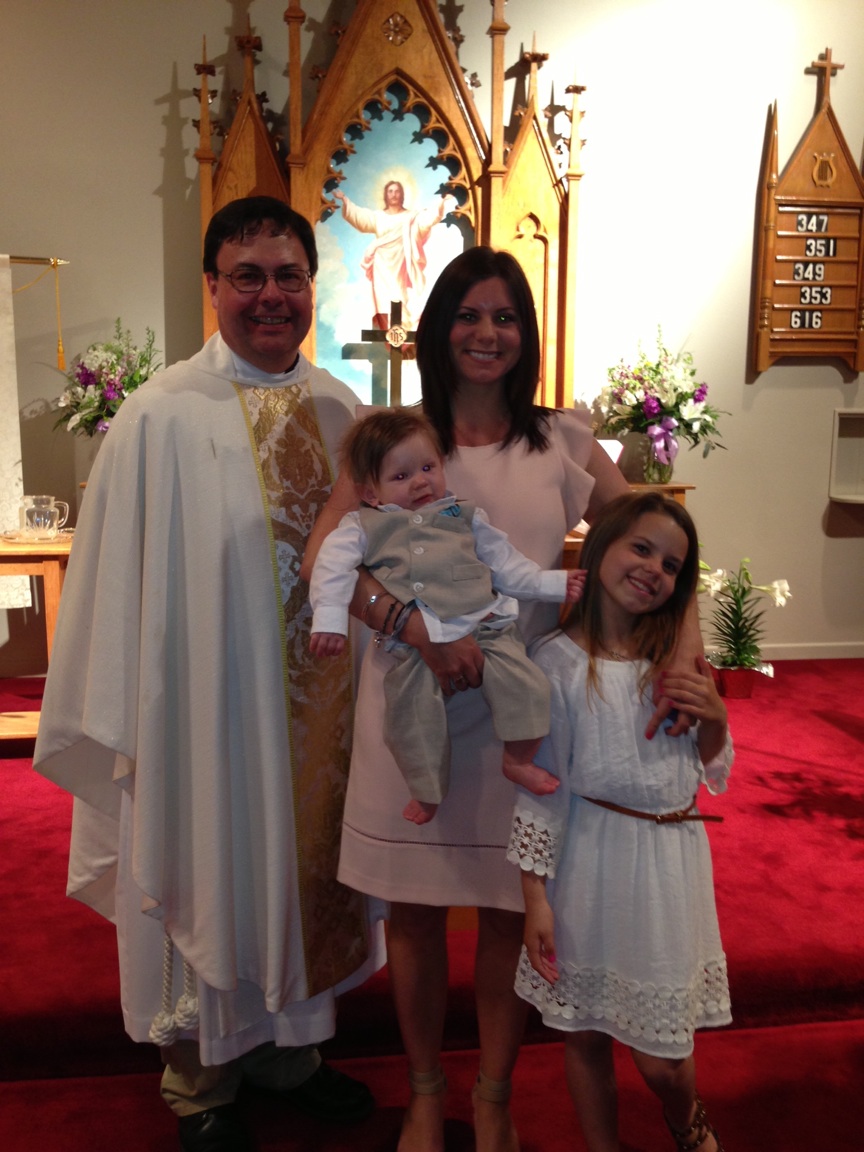
At the Great Vigil of Easter – Saturday, April 19, 2014, we welcomed three new Christians into God’s family:  Tonia, Ally and Judd.  Each of these received the Sacrament of Holy Baptism at the Vigil.  We are very thankful for God’s gift of faith and the work he is already doing in the lives of these three.  As newly baptized Christians they are also new members of MLLC.  Ally and Tonia also received the Sacrament of Holy Communion for the first time as Christians at this service.  It was a joyful evening for all involved.

Check out this page to learn more about our Great Vigil of Easter.


The Great Vigil of Easter is the ancient time when New Christians have been baptized.  Every year, including 2014, thousands of people are baptized all over the world at  Great Vigil of Easter services such as we had at MLLC.  Many congregations also use this special service to receive new members into the congregation.  My own son was baptized at the Great Vigil of Easter in 2004 at the congregation I served in North Liberty, Indiana, at that time.


Here are some more photos from the baptisms of Tonia, Ally and Judd on April 19.

Vigil Baptism 2 Vigil Baptism 3 Vigil Baptism 4

The Biggest Night of the Year – the Vigil of Easter

Image

This is the Night when we gather for the Vigil of Easter. It is an ancient special service of the Church.  It is very different than anything else we do throughout the year. We gather at 7 p.m. on Saturday Night, April 19.  We look forward to seeing you at the Great Vigil of Easter.

Here is the rest of our Holy Week Schedule:  Click link.

Here is a perspective on this day from Deaconess Jennifer Clark Tinker, who is a member at Martin Luther Lutheran Church:  click this link for Jen’s Reflection.

Here is the introduction to this day as we will have it in our service bulletin:

An Introduction to the Vigil of Easter
Like the children of Israel who watched and waited through the night for the Lord of the Exodus, we too come together this night to watch and wait for the Lord of the Resurrection. We come, as Christians have come since the first century, to keep vigil and to prepare ourselves for the arrival of the Bridegroom who is chief host and guest at the Resurrection feast to come.
First, we must break the darkness of the night. Like the virgins in the parable, we must light our vigil lights. Our light will be a very special light, for it is the light of Christ which burns atop the Paschal candle and which dispels the darkness — of night, of sin, of death. Our light will be a constant reminder of the Resurrection victory during the coming season, at every baptism and at every funeral. But for now, it will burn in vigil as we await the Bridegroom.
When we have settled into our pews for the watch, we hear the storytellers among us sharing the stories of our faith — the stories of God’s salvation history and the covenants which he made with our people. These are our “family” stories. We listen. We sing. We watch. And we wait for the feast to come.
After hearing our stories, we make our last minute preparations to meet our Lord. All must be right for the feast. On some years those among us who have not yet joined us are brought into membership with us this night, making all who are here part of the family, which is the Church and the Bride of Christ. Each year, so that the whole family is prepared, each of us renews our baptismal vows. As we interact with the water and the Lord, we hear and we feel that grace which was given to us through our baptism.
We are nearly ready. The time is close. We prepare the room and set the table for the Feast of Victory, the First Holy Communion of this greatest festival day of all. And then at last He comes! The Resurrection victory is won! The Bridegroom has come through the darkness to claim his Bride, the Church, to be his own. This is the feast of victory! In the end flowers and banners must adorn the space, for our time this evening and tomorrow will be a feast to remember.


Thanks to Pr. Thomas L. Weitzel, ELCA.  This introduction was adapted from his original work.

Introduction to Good Friday

jesus-christ-crucifixion-395

As part of our Good Friday service bulletin we include this introduction to the service.

We gather to worship the Crucified Savior tonight at 7 p.m., Friday, April 18, 2014.


An Introduction to Good Friday – Tenebrae

We begin our liturgy as we ended the Maundy Thursday Liturgy: in silence. What was begun then continues this day as we journey with our Savior from the Last Supper, the stripping and humiliation, to the cross and tomb. Good Friday is the second day of the Triduum, the “Three Sacred Days” of Maundy Thursday, Good Friday, and Holy Saturday with its Vigil of Easter.


The Good Friday Liturgy is marked with austerity, silence and reflection. The chancel itself is bare from the Maundy Thursday stripping. There is no organ music except to accompany the hymns and sung musical pieces. Everything focuses on our adoration of the crucified Christ, reigning from the throne of the cross.


The service of Tenebrae is an ancient Holy Week devotion which began in the 7th or 8th century, or possibly earlier. The name “Tenebrae” means shadows. The service takes its name from the ceremony of extinguishing in succession all the lights in the sanctuary, casting it into total darkness which is symbolic of the disciples’ desertion of our Lord, and of his death and burial.


The purpose of the Tenebrae Service is to aid us in realizing the total impact of the darkest day in the history of the world, the day Jesus died on the cross.


The opening portion of the liturgy includes no praise. It proceeds directly to the Prayer of the Day. It is a simplified version of our Sunday Liturgy of the Word. The chief acts are the reading of the Passion of St. John and the Bidding Prayer for the needs of our world. After each section of the Passion of St. John is read, there will be a time of silent meditation. Lights will begin to be extinguished or dimmed more after each reading and meditation until the sanctuary is in darkness.


A large cross, which vividly and dramatically portrays the events of this day, is then brought into the church in solemn procession to become the focus of our adoration of the crucified Christ. Placed upon at the front of the chancel, the crucifix is central to our meditations in word and in silence. The words of meditation are the ancient Reproaches. The words of reproach are those of God directed to us, his people, who have crucified the Savior of the world by our sin. The Reproaches expand upon the words of the prophet Micah (6:3-5) and burn in our hearts. The liturgy does not end on this note of reproach, however. The closing versicles and prayer emphasize the triumph and redemption that comes through the cross.


After the lights are all extinguished, the congregation will stand as the Paschal Candle is carried from the sanctuary reminding us of the burial of Jesus. A loud noise, made by the closing of a Bible, will remind us of the closing of the tomb as well as the fulfilling of the Scriptures and the completion of our Lord’s work on the cross for us.


The Paschal Candle (called the Christ Candle during Advent/Christmas) will not return until the beginning of the Great Vigil of Easter on Saturday evening at 7 p.m. On Good Friday we recognize that Jesus was fully dead and was placed in the borrowed tomb.


Note: The return of the Paschal Candle moments after the loud noise is a form of the Good Friday service designed to be used in those congregations which do not have the Great Vigil of Easter.


All will leave in silence to return tomorrow as we wait in vigil and then celebrate our Lord’s resurrection at the Great Vigil of Easter. At the Vigil tomorrow evening we will have the first Holy Communion in celebration of the Resurrection of our Lord Jesus Christ.

After the Triduum we will continue our celebration on Sunday morning with the Sunrise service at 7:30 at the Carmine Cemetery, breakfast in the fellowship hall at 8 a.m. and the Festival Service at 9:00 a.m. Around 10:15-10:30 a.m. we will have the Resurrection Egg hunt and party for the children.

Click here to see the first post in this series about Maundy Thursday.


Thanks to Pr. Thomas L. Weitzel, ELCA.  This introduction was adapted from his original work.

Introduction to Maundy Thursday

Image

We gather this evening at 7 p.m. for Worship on this Maundy Thursday.

Here is the introduction to this Sacred Day which we use at Martin Luther Lutheran Church in Carmine.

An Introduction to Maundy Thursday
The Maundy Thursday service is one of endings and beginnings. What was begun on Ash Wednesday is brought to a close here today. What begins today does not end until the Day of Resurrection. It is the ancient Triduum, “The Three Sacred Days,” which lead us to the celebration of the Resurrection of our Lord: Maundy Thursday, Good Friday, and Holy Saturday.
The theme is love, our Savior’s love for us, expressed in the washing of the disciples’ feet, in giving himself in bread and wine, in dying upon the cross. An invitation to confession is given. The focus is on forgiveness. On Ash Wednesday, we began Lent with a major act of confession and ashes, but we did not receive a strong statement of forgiveness in the absolution. That bold announcement of forgiveness comes now, “In the mercy of almighty God,” and “in the name of the Father, and of the Son, and of the Holy Spirit,” at the service celebrating Christ’s love.
The lessons of love are read. A new command derives from it: “Love one another.” The name “Maundy” comes from the first word of the Latin form of John 13:34: “Mandatum novum do vobis ut diligatis invicem sicut dilexi vos” (“I give you a new commandment, that you love one another. Just as I have loved you, you also should love one another.”). This self-giving love is demonstrated in the washing of feet. The prayers are said. The table is made ready. The time of the Lord’s Supper arrives, and our Lord is revealed in bread and wine as once he “revealed himself to his disciples.” It is a solemn moment, but we cannot linger here. Nor could the Lord, for His betrayal was imminent.
Before we know it, the markings of betrayal are seen before us. The symbol of Christ in our midst, the altar, is stripped bare. Christ is stripped of his power and glory. Good Friday is inescapable. The powers of darkness work upon him.
In silence, we depart without benediction. The Three Sacred Days continue with the Good Friday service tomorrow at 7:00 p.m. We will also gather on Saturday evening at 7 p.m. for the Vigil of Easter.


Thanks to Pr. Thomas L. Weitzel, ELCA.  This introduction is adapted from his original work.


Holy Week Message from our Presiding Bishop

Image

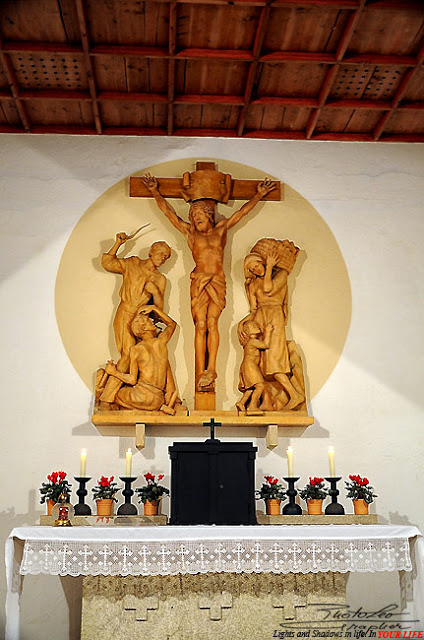
Photo from the Flossenburg Chapel, as noted in the Good Friday Message.  This photo is from this blog site:  click


We are in the midst of Holy Week 2014.  We have moved from the joyful entry of Jesus into Jerusalem, and we remember that he is headed to the cross.  As we follow in the way of Jesus we reflect on the truth of the cross.  Here is a powerful message from our ELCA Presiding Bishop Elizabeth Eaton.

Click this link for the Good Friday Message

Image

Presiding Bishop of the Evangelical Lutheran Church in America (ELCA) – the Rev. Elizabeth Eaton

This was first published in “The Lutheran” magazine, and comes to us through our Texas Louisiana Gulf Coast Synod web site blog.

Reflecting on Ash Wednesday

Image

Adapted by Pr. David Tinker, from an original article by Pr. Thomas L. Weitzel

The Ash Wednesday service at Martin Luther Lutheran Church of Carmine will be on Wednesday, March 5, 2014, at 7:00 p.m.


This day is something of a slap in the face, especially when one hears the words, “Remember that you are dust, and to dust you shall return.”  The original name – “Day of Ashes” – was a reference to the ancient Christian practice of sprinkling or rubbing ashes on the head or forehead as a sign of one’s mortality.  The same ancient gesture appears in the baptismal liturgy: a cross is traced with oil on the forehead of the person being baptized.  In this simple gesture the person is claimed by Christ.


There can be no more solemn and appropriate action on this day than to distribute ashes to all who gather for the beginning of the Lenten season.  Here the young and ole, men and women, rich and poor, learned and simple.  Here the cross is the sign of salvation that all believers share.  It is the sign of death and resurrection.


What is Ash Wednesday?

On Ash Wednesday, the community of faith comes face to face with two realities.  First, we confront our own mortality.  None of us lives in this life forever. Secondly, all of us are sinners and need to confess our sin to God.  These two themes (death and sin) are brought together in light of God’s redeeming love in Jesus Christ.  As the Apostle John says in 1 John 1:9b, “…(God) who is faithful and just will forgive us our sins and cleanse us from all unrighteousness.”  The confession of sin on Sundays reminds us, “In the mercy of almighty God, Jesus Christ was given to die for us, and for his sake God forgives us all our sins.”  The Lutheran Book of Worship (1978) confession also included, “To those who believe in Jesus Christ he gives the power to become the children of God and bestows on them the Holy Spirit.”


What are the ashes for?

The “ashes” of Ash Wednesday are rooted in the ancient worship of both the Jewish and Christian communities.  They are a sign of mortality and penance.  Even though we have used the imposition of ashes in our Ash Wednesday worship for many years, they still may seem new or uncomfortable to us.  What we should remember about the ashes is they are a visible sign of our cleansing and rebirth, a recognition of our daily dependence on God for life and a promise of eternal life through Jesus Christ.


Should I receive the ashes?

The ashes are not compulsory by any means.  You may choose, if you wish, to remain in your seat during the imposition of ashes.  But remember that they are a powerful way and a visible way to participate in the call to repentance and reconciliation.  If you choose to participate, come forward at the appropriate time in the liturgy with others desiring the ashes.  The pastor will did his thumb in the ashes and trace the sign of the cross on your forehead.  Afterwards, return to your seat and the liturgy will continue.


Pr. Thomas L. Weitzel’s excellent liturgy site is:  http://liturgybytlw.com/

The Presentation of our Lord: Candlemas – February 2, 2014

Image

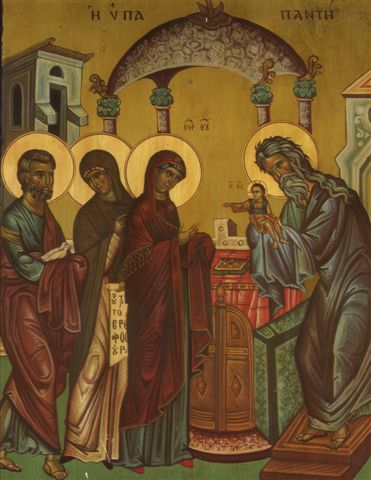
An Icon of the Presentation of our Lord

By Pastor David Tinker

This coming Sunday will be very special and a little bit different this year.  We will be celebrating what is called the feast of the Presentation of our Lord.  On February 2 each year the church celebrated the presentation of Jesus in the Temple at Jerusalem. Ancient Jewish law required that, following the birth of a firstborn male child, the mother must come to the temple after 40 days for purification and for presentation of the child to the Lord.  February 2 is the 40th day of Christmas.  Christmas Day being day 1; February 2nd being day 40.

The presentation of Mary’s child, however, was different from most. This was the Christ Child, Jesus, the Savior, the Messiah who had been promised. And he was recognized as such by the old prophet Simeon, who knew that this child was “a light for revelation to all nations.” Thus the image of light carries an important part in this day’s liturgy and links itself with the Christmas season and its lights of the Advent wreath, the decorative tree lights, and the many candles of the Nativity celebration.

To mark this particular feast, the ancient tradition calls for 1) the blessing of candles and burning oils to be used during the year and 2) a procession “to meet the Lord,” just as Simeon and Anna went to the Temple and found the Christ there. The liturgy is called “Candlemas” (the Candle Mass).

At the beginning of our liturgy, our children will gather in the chancel for a special children’s sermon to hear about the significance of this day. After the blessing of the candles, they will represent the congregation in procession around the church as we all come into God’s temple “to meet the Lord,” who is the Light of the world.

Check out the readings for this day, especially the Gospel reading from Luke which tells of Jesus’ visit to the Temple.

Malachi 3:1-4; Psalm 84; Hebrews 2:14-18; Luke 2:22-40

Here is another special note about this day.  In the reading from Luke we have the Canticle of Simeon, often called the “Nunc Dimittis”.  This is Latin phrase which begins this Canticle of Simeon.  Many churches use this Canticle of Simeon during funerals.  Since my arrival as pastor at Martin Luther Lutheran Church in Carmine we have been using this statement as well.  Here is what we use in the funerals:

“Lord, now you let your servant go in peace:

your Word has been fulfilled.

My own eyes have seen the salvation

which you have prepared in the sight of every people:

a light to reveal you to the nations

and the glory of your people Israel.   (Luke 2:29-32)

Glory to the Father, and to the Son, and to the Holy Spirit,

As it was in the beginning, is now and will be forever.”

This Canticle of Simeon is used because of the context of its original use in Luke chapter 2.  Simeon was promised by God that he would not die until he had met the Lord’s Messiah.  He was likely a bit older, possibly around the age of Anna (noted in Luke 2:36-38). She was 84 years old.  Upon meeting the Messiah, Jesus, Simeon could rest in peace.  When a Christian, who is a person who has met the Messiah, has died, we remember his or her relationship with God and the fulfillment of God’s promises when we share this Canticle of Simeon.

Original Text by Pr. Thomas L. Weitzel, adapted and added to for use at MLLC and mllccarmine.com by Pr. David J. Tinker

Andy’s Toys and the People of Jesus

Jan1214 Andy Foot Toy Story

by Pastor David Tinker

In my sermon on Sunday, January 12, 2014, I shared about the following from the movie, Toy Story.  I found an image of the foot of Woody with Andy’s name written on it.  Here is a written form of what I shared in the Sunday sermon regarding this image.

“The 1995 movie Toy Story shows Andy’s toys come to life.  When Andy is not around the toys talk, move, and have a sort of community life.  Andy is a little boy who cherishes his toys, but he especially cherishes his toy Cowboy “Woody”.  The story goes that on Andy’s birthday he receives a very exciting new toy:  Buzz Lightyear.  Buzz is a Space Ranger, complete with a laser beam, space helmet and a means to communicate between planets.  Buzz Lightyear becomes the new favorite toy of Andy.  He even makes sure his name is written on the bottom of Buzz Lightyear’s foot with permanent ink.

The Buzz Lightyear toy, while Andy is away, gets the impression that he himself is the real Buzz Lightyear, rather than a toy like the rest of the community.  After a series of mishaps he is brought to the reality that he is just a toy.  Buzz goes into a blue funk and no longer cares to even be a toy.

This is when the original leader of the toys, Woody, starts to show his stuff.  Woody truly cares about the toys and he also understands their purpose.  All the community of toys are “Andy’s Toys”.  They are there for Andy to play with.  Andy’s Toys are special, important and are loved by Andy.  Andy cares so much about his toys that he puts his name on each one.  Woody shows Buzz that both Woody and Buzz have the mark of Andy on their feet.  Woody shows Buzz that each toy is special not because of what they can do, but because they belong to Andy.  They are Andy’s Toys.”

The Epiphany of our Lord – January 6

Visit of Magi Icon


By Pastor David Tinker

To help us celebrate the Epiphany of our Lord I share with you a favorite poem of mine.  It was written by the great American Poet, Henry Wadsworth Longfellow (1807-1882).

The Three Kings
By Henry Wadsworth Longfellow

Three Kings came riding from far away,
Melchoir and Gaspar and Baltasar;
Three Wise Men out of the East were they,
And they travelled by night and they slept by day,
For their guide was a beautiful, wonderful star.

The star was so beautiful, large, and clear,
That all the other stars of the sky
Became a white mist in the atmosphere,
And by this they knew that the coming was near
Of the Prince foretold in the prophecy.

Three caskets they bore on their saddlebows,
Three caskets of gold with golden keys;
Their robes were of crimson silk with rows
Of bells and pomegranates and furbelows,
Their turbans like blossoming almond trees.

And so the Three Kings rode into the West,
Through the dusk of night, over hill and dell
And sometimes they nodded with beard on breast,
And sometimes talked, as they paused to rest,
With the people they met at some wayside well.

“Of the child that is born,” said Baltasar,
“Good people, I pray you, tell us the news;
For we in the East have seen his star,
And have ridden fast, and have ridden far,
To find and worship the King of the Jews.”

And the people answered, “You ask in vain;
We know of no king but Herod the Great!”
They thought the Wise Men were men insane,
As they spurred their horses across the plain,
Like riders in haste, and who cannot wait.

And when they came to Jerusalem,
Herod the Great, who had heard this thing,
Sent for the Wise Men and questioned them;
And said, “Go down unto Bethlehem,
And bring me tidings of this new king.”

So they rode away; and the star stood still,
The only one in the gray of morn;
Yes, it stopped, it stood still of its own free will,
Right over Bethlehem on the hill,
The city of David where Christ as born

And the Three Kings rode through the gate and the guard,
Through the silent street, till their horses turned
And neighed as they entered and great inn-yard;
But the windows were closed, and the doors were barred,
And only a light in the stable burned.

And cradled there in the scented hay,
In the air made sweet by the breath of kine,
The little child in the manger lay,
The child, that would be king one day
Of a kingdom not human but divine.

His mother Mary of Nazareth
Sat watching beside his place of rest,
Watching the even flow of his breath,
For the joy of life and the terror of death
Were mingled together in her breast.

They laid their offerings at his feet;
The gold was their tribute to a King,
The frankincense, with its odor sweet,
Was for the Priest, the Paraclete,
The myrrh for the body’s burying.

And the mother wondered and bowed her head,
And sat as still as a statue of stone;
Her heart was troubled yet comforted,
Remembering what the Angel had said
Of an endless reign and of David’s throne.

Then the Kings rode out of the city gate,
With a clatter of hoofs in proud array;
But they went not back to Herod the Great,
For they knew his malice and feared his hate,
And returned to their homes by another way.