Devotion and Readings May 1

Tabgha Baptismal Bowl

Bible Readings and Devotion for May 1, 2020


Here are the references for the readings.  Please look these up in your print Bible, your smartphone app Bible, or your online Bible:

John 6:1-14

1 Corinthians 15:35-49

Psalm 146, 147

Ezekiel 21


Devotion for May 1, 2020

By Pastor David Tinker


There is one ministry miracle account which is presented in all four of the Gospel Books:  Matthew, Mark, Luke and John.  It is the account of the Feeding of the Five Thousand.  Our reading from John 6 tells this story in John’s Gospel book.  This event shows the people, and us, that God is powerful and provides us what we need.  This miracle also points us to the Sacrament of Holy Communion.  This Sacrament points us to the most important thing of all:  the suffering, death and resurrection of Jesus Christ for the forgiveness of our sin.

In August 2014 MLLC acquired a communion set which shows an ancient depiction of the Feeding of the Five Thousand.  The article about this tells more about the special communion set as well as information about the miracle and the historic location of this miracle.

Click this the link to that article on our web site from several years ago.


Prayer

Almighty God, Father, Son, and Holy Spirit, you love us beyond measure. Help us to know you and to understand the depth of your love for us.  Enliven our faith, and guide us to trust in you as the bread of life for the world.  We pray this in the Holy Name of Jesus Christ our Lord. Amen.

Devotion and Readings April 30

Hubble Space Telescope Westerlund 2
The star cluster Westerlund 2 as photographed from the Hubble Space Telescope. Photo Credit: ESA/Hubble


Bible Readings and Devotion for April 30, 2020


Here are the references for the readings.  Please look these up in your print Bible, your smartphone app Bible, or your online Bible:


John 5:36-47

1 Corinthians 15:29-34

Psalm 144, 145

Ezekiel 20


Devotion for April 30, 2020

By Pastor David Tinker


One of the benefits of living in a mostly rural area of Texas is being able to see the stars at night.  There is even a song about that.  “The stars at night – are big and bright, Deep in the heart of Texas.”  I can tell, this is true.  It reminds me of what we read in Psalm 8:1-4:

“O Lord, our Sovereign, how majestic is your name in all the earth! You have set your glory above the heavens.  Out of the mouths of babes and infants you have founded a bulwark because of your foes, to silence the enemy and the avenger. When I look at your heavens, the work of your fingers, the moon and the stars that you have established; what are human beings that you are mindful of them, mortals that you care for them?”

As we look at the glorious heavens, the vast expanses of space and creation, we can be overwhelmed at times. The point of Psalm 8 is to remind us that the Lord, who made the vast universe, actually cares about us.  This eventually points us to the work of Jesus Christ.  The Lord cares so much about us that he entered human life and reality.  That is part the message of Philippians 2:5-8, which read:

“Let the same mind be in you that was in Christ Jesus, who, though he was in the form of God, did not regard equality with God as something to be exploited, but emptied himself, taking the form of a slave, being born in human likeness. And being found in human form, he humbled himself and became obedient to the point of death—even death on a cross.”

The amazing, powerful and glorious creator of all that exists has humbled himself to join life with us.  The fullness of God and his Word are brought to a tiny, intense focus in the person of Jesus Christ.  Jesus, God the Son, brought all of God’s power together for the sake of the human race.  All of God’s goodness, mercy, and self-giving love have been focused through Jesus for you, for me.  In relation to the world, the solar system, the universe, that is very small indeed.

That small speck of creation, either just the world, or just one person, is infinitely important to God.  The tight focus on the life and eternity of us points to a dramatic truth.  That is where today’s reading from Psalm 145 helps us ponder the things of God.  Here is verse 3:

“Great is the Lord, and greatly to be praised; his greatness is unsearchable.”

Look at that last phrase, “his greatness is unsearchable.”  It is a poetic way of presenting a truth about the Lord.  He is more amazing than we can ever truly understand.  It is quite a bit like looking at the stars at night in Texas.  They are big and bright.  If you were to try to count these stars and objects you would run out of time in this earthly life.

Thirty years ago, our nation launched a special satellite, the Hubble Space Telescope.  This helped us see the vast universe without obstruction from our atmosphere.  The photos show us the beauty of what is out in space.  We can now see things beyond our imagination.  See this photo of stars. Photo credit:  ESA/Hubble

A snowstorm of stars

There is curious thing about our observation of things beyond earth.  The further we look the more we discover, and this leads to more discovery.

The Lord is like that in sense.  The Lord is knowable through the means he has provided:  Jesus, Holy Scripture, Sacraments, observing creation, etc. As we dig deeper into knowing and understanding the Lord, the more we find that there is more to him than we can fully comprehend.  As we ask questions, and find answers to many things about the Lord, it leads us to more questions.  New questions do not mean we stop seeking greater understanding of the Lord.  If we stopped seeking to know God it would be as though we launched the Hubble Space Telescope, took a few photos, and then shut the thing down because it showed us that there is more to seek to see.

“His greatness is unsearchable,” tells us that the Lord is abundantly amazing.  We could spend a lifetime looking into the Lord’s work and Word, and we can still learn more.  Even after numerous readings of the Holy Scriptures I continue to find more things I didn’t notice earlier.  I continue to get to know the Lord in many and various ways.  Yes, I do find challenging things, but that doesn’t need to stop me.  With God’s help I can, we all can, seek to search the greatness of our Lord.


Prayer

Gracious and holy God, give us diligence to seek you, wisdom to perceive you, and patience to wait for you. Grant us, O God, a mind to meditate on you; eyes to behold you; ears to listen for your word; a heart to love you; and a life to proclaim you; through the power of the Spirit of Jesus Christ, our Savior and Lord.  Amen.


Prayer from Evangelical Lutheran Worship. Copyright © 2020 Augsburg Fortress. All rights reserved.


Devotion and Readings April 29

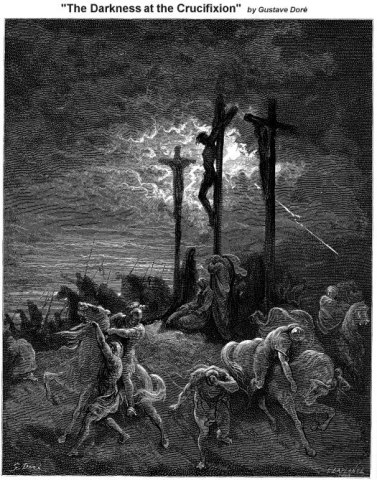
jesus-christ-crucifixion-395

Bible Readings and Devotion for April 29, 2020


Here are the references for the readings.  Please look these up in your print Bible, your smartphone app Bible, or your online Bible:


John 5:24-35

1 Corinthians 15:20-28

Psalms 140, 143      

Ezekiel 19


Devotion for April 29, 2020

By Pastor David Tinker


There was an annoying “game” among boys in my school and peer group in elementary school.  They called it, “Mercy.”  They would harass, tackle, poke, tickle, slap, and pin down another boy.  The attackers would say to the hurting youth, “Say ‘mercy.’”  They would continue the unpleasantness until the boy begged for mercy.  Then, because he said, “mercy,” they would make fun of the boy for having to beg for mercy.  That was a miserable, sinful action by the youth.

In scripture there is a teaching approach which can be summed up as, “From the lesser to the greater.”  This means that the teacher notes a lesser thing, and then shows how God does a much greater thing for our benefit.  The bullying behavior of seven-year-olds is about mercy of sorts.  God’s mercy is so much better.  It is something which brings life and hope and relief to a suffering humanity.

Before getting into our reading today about mercy, let’s look at an example of, “from the lesser to the greater,” in the New Testament.

When teaching about prayer in Luke chapter 11, our Lord Jesus notes, “So I say to you, Ask, and it will be given you; search, and you will find; knock, and the door will be opened for you. 10 For everyone who asks receives, and everyone who searches finds, and for everyone who knocks, the door will be opened. 11 Is there anyone among you who, if your child asks for a fish, will give a snake instead of a fish? 12 Or if the child asks for an egg, will give a scorpion? 13 If you then, who are evil, know how to give good gifts to your children, how much more will the heavenly Father give the Holy Spirit to those who ask him!”

In this, the sinful parent does a decent job of making sure one’s child gets a safe and appropriate meal when asked for by the child. How much more will God give us what we need for faith and life when we ask for it.  This points to the greatest gift of God being the Holy Spirit.

So, when teaching about mercy, we can use the “lesser to the greater” principle.  The harassing boys showed a mercy of sorts to the peer they were pushing around.  This is where we see something which points to mercy in our reading from Psalm 143.  Here is what is noted in Psalm 143:2: “Do not enter into judgment with your servant, for no one living is righteous before you.”  The psalm writer is praying for God’s continued mercy.  The powerful thing here is that people who are alive are recipients of God’s abundant mercy already.   They are receiving it even without begging for it.  God is not pushing and slapping us into begging for mercy.  Rather, he is offering it to us right now.

In the Old Testament we have this strong statement of the Lord in Hosea 6:6, which reads, “For I desire steadfast love and not sacrifice, the knowledge of God rather than burnt offerings.”  Other translations note it as, “For I desire mercy…” What the Lord wants for us in mercy.  This is show in various ways in the New Testament. One is in Peter’s writings.

The Apostle Peter notes, “8 But do not ignore this one fact, beloved, that with the Lord one day is like a thousand years, and a thousand years are like one day. 9 The Lord is not slow about his promise, as some think of slowness, but is patient with you, not wanting any to perish, but all to come to repentance.”  God’s mercy is shown over and over again for humanity as he shows patience for us.  The patience is offered to help us get back on track with the Lord.

The mercy of God is already present for us.  In this psalm, we are reminded to be aware of this steadfast mercy and love for us.  The faithful response is filled with repentance, thanksgiving, and service to God and others.


Prayer

Direct us, O Lord God, in all our doings with your most gracious favor, and extend to us your continual help; that in all our works begun, continued, and ended in you, we may glorify your holy name; and finally, by your mercy, bring us to everlasting life; through Jesus Christ, our Savior and Lord. Amen.


Prayer from Evangelical Lutheran Worship. Copyright © 2020 Augsburg Fortress. All rights reserved.

Devotion and Readings for April 28


John the Baptist Francesco Granacci

Bible Readings and Devotion for April 28, 2020


Here are the references for the readings.  Please look these up in your print Bible, your smartphone app Bible, or your online Bible:

John 5:16-23

1 Corinthians 15:12-19

Psalms 139, 141, 142 

Ezekiel 18


Devotion for April 28, 2020

By Pastor David Tinker


Playing board games with others was a regular activity of my younger years.  I didn’t care so much about winning, for it was just a joy to spend time with others.  Some of those with whom I played these games had a different attitude.  They were happy when everything was going their way.  They were melancholy when things were about even.  They were angry, sad, upset, etc. when they were losing.  Sometimes they would just up and quit.  I recall that some of these fellow players over the years would accuse other of cheating, or that the game was unfair.  A few would event upend the game board and run off angry or crying.  It wasn’t right or good, but it is what I experienced at times.

Today in Ezekiel’s book we read a prophetic word about how the people claim God is unfair.  It seems that those who are wicked are complaining that God desires that people turn from their sins and live according to God’s way.  Maybe they want to keep doing wrong, but want to have God’s favor?  They want to have all the benefits of God, but none of the responsibility and new way of living.

Ezekiel shared God’s response to this contradictory idea.  “Yet you say, “The way of the Lord is unfair.” Hear now, O house of Israel: Is my way unfair? Is it not your ways that are unfair?” In other words, “This is nonsense.  You complain that you can’t have it both ways.  Your expectations of God are unworkable.”

In the end, what the Lord is calling the people to is repentance.  This is when we stop doing the wrong, respond to the connection with the Lord, and, with his help, we strive to live according to his ways.  The unfair response of sinful humanity is to grumble that God wants a better and more holy life for each of us.

We talk a great deal about repentance during the season of Lent.  For 2020, Lent is over, but the Lord’s will for us continues all year, every year.  That he calls on us to turn from our sin to live for God alone has nothing to do with being unfair. Repentance is the core response to the grace of God.  In Mark 1:14-15, we have the first sermon of Jesus.  Mark writes, “Now after John was arrested, Jesus came to Galilee, proclaiming the good news of God, and saying, “The time is fulfilled, and the kingdom of God has come near; repent, and believe in the good news.””  In this, God’s goodness, mercy, and grace, enter our lives, and the logical and God willed response is that we repent.

John the Baptist, who was sent to prepare the way for Jesus’ ministry, spoke of this repentance as well.  He said in his sermon recorded in Matthew 3:8, “Bear fruit worthy of repentance.”  What does this look like? It looks like a life led by God the Holy Spirit.  Martin Luther wrote the following in his Small Catechism.  This is from the second about the Holy Spirit:


The Apostles Creed – The Third Article: On Being Made Holy

I believe in the Holy Spirit, the holy catholic church, the communion of saints, the forgiveness of sins, the resurrection of the body, and the life everlasting.

What is this?

I believe that by my own understanding or strength I cannot believe in Jesus Christ my Lord or come to him, but instead the Holy Spirit has called me through the gospel, enlightened me with his gifts, made me holy and kept me in the true faith, just as he calls, gathers, enlightens, and makes holy the whole Christian church on earth and keeps it with Jesus Christ in the one common, true faith. Daily in this Christian church the Holy Spirit abundantly forgives all sins—mine and those of all believers. On the last day the Holy Spirit will raise me and all the dead and will give to me and all believers in Christ eternal life. This is most certainly true.


Since the Holy Spirit is who makes it possible for us to believe, to return to God, to be connected with God, then the fruit of repentance is the Fruit of the Spirit.  We read about these in Galatians 5:22-23, “By contrast, the fruit of the Spirit is love, joy, peace, patience, kindness, generosity, faithfulness, gentleness, and self-control. There is no law against such things.”

Sometimes we may be brought kicking and screaming into God’s will.  Sometimes we may not like the call to repentance.  Sometimes we may resist the urging of the Holy Spirit.  Sometimes we may accuse God of being unfair for calling us to a new way of life.  In the end, we rest in God’s grace, and, by the Spirit, respond to God’s call to repentance.  God’s fairness is that he offers his abundant mercy to the whole world, and that includes you and me.


Prayer

Almighty God, by our baptism into the death and resurrection of your Son, Jesus Christ, you turn us from the old life of sin. Grant that we who are reborn to new life in him may live in righteousness and holiness all our days, through your Son, Jesus Christ our Lord. Amen.


Prayer from Evangelical Lutheran Worship. Copyright © 2020 Augsburg Fortress. All rights reserved.


Devotion and Readings for April 27

Sabbath Healing

Icon of Jesus Healing on the Sabbath.


Bible Readings and Devotion for April 27, 2020


Here are the references for the readings.  Please look these up in your print Bible, your smartphone app Bible, or your online Bible:


John 5:1-15

1 Corinthians 15:1-11

Psalms 136, 137, 138

Ezekiel 17


Devotion for April 27, 2020

By Pastor David Tinker


One of the great idols of humanity is the desire to control others.  It is not an idol such as the false gods of the nations around the Israelites.  Rather, this idol is simply a situation which one looks to for a sense of power and control.  There is a sense of satisfaction for some when they make others do things their way.

This comes up in all sorts of contexts.  In politics and in revolutions the desire to control others is quite common. The people or a subgroup will rise up against the oppressive government.  They will promise freedom for the nation.  Then, when the revolutionaries have taken control of the government, they begin their program of rules for controlling the people.

It comes up in organizations, communities, groups, among friends, and even families.  Someone will try to set the rules for others.  Another will like it when they can make another person do their will.

The idol of control is also a way avoiding dealing with one’s own sinfulness.  In today’s reading from John 5 we have most of an account of Jesus healing on the Sabbath.  There is a negative reaction to his life-giving work.  The Jewish leaders condemn his actions, the actions of the man who was healed.  He had picked up the mat on which he formerly sat or rested due to his ailment.

It often feels as though these leaders who enforced the liked to control others.  Their insistence on the rules seems to be, at least in part, a way for them to control others.  People were being made to observe the Sabbath for Sabbath’s sake.  Jesus turned this around and taught us to observe the Sabbath, to have a day for rest, learning and worship, for our benefit.  It is possible that the control of others regarding the Sabbath was, at least in part, a means for the people enforcing the rules to keep from dealing with their own sin.

The gift of Sabbath time for us today is for our benefit. We get to use sabbath time for rest and worship.  It is not about telling others what they should do.  It is not our job to force the world to do things our way.  Rather, we must first look at what we are doing as compared against God’s most excellent way.  Then we get to confess our sin to God.  Following this, we are called to work out our salvation with fear and trembling, as St. Paul teaches us in Philippians 2:12-13.  That means, we work with God to correct what is off or wrong in each of our lives with the Lord.


There are at least three reasons that we don’t need push on others about their Sabbath keeping.

1) We are not called upon to control others.  The Sabbath was mean for bringing life and freedom to people, not so that others can tell them what to do.

2) We need to spend time working on how God is guiding us and saving us from the power of sin and death.  We need to work out our salvation with fear and trembling.  If you struggle with our own issues related to Sabbath, rest, and worship, then you have your work cut out for you.

3) We need to address our own sinfulness.  Jesus teacher about this in Matthew 7:1-5 as well as in Luke 13:1-5.

If we strive to address these three things in our life with God, then we will lack for leisure time to lay into others about their sin and lack of Sabbath keeping.


Prayer

Keep watch, dear Lord, with those who work or watch or weep, and give your angels charge over those who sleep. Tend the sick, give rest to the weary, bless the dying, soothe the suffering, comfort the afflicted, shield the joyous; and all for your love’s sake. Amen.


Prayer from Evangelical Lutheran Worship. Copyright © 2020 Augsburg Fortress. All rights reserved.


Devotion and Readings for April 25 & 26

26C6BEDD-5500-49B2-ADCD-DBE39BC1D0F4


Bible Readings and Devotion for April 25 & 26, 2020


Here are the references for the readings.  Please look these up in your print Bible, your smartphone app Bible, or your online Bible:


April 25

John 4:27-45  

1 Peter 5:1-14

Psalm 127-131

Ezekiel 15


April 26

John 4:46-54  

2 John 1-13

Psalm 132-135

Ezekiel 16


Devotion for April 25 & 26, 2020

By Pastor David Tinker


The Psalms include some of the shortest chapters in the Bible.  The numerous psalms today are some of those short ones.  Psalm 134 contains three verses, yet these are tremendous.

Verse 1: “1 Come, bless the Lord, all you servants of the Lord, who stand by night in the house of the Lord!”

This is an invitation to the people of God to know and honor the Lord.  It is a call to worship of sorts. It is a, “Song of Ascents.”  These are songs which the people sang in celebration of the Lord’s goodness and glory.  They sang these as they went up to or ascended to the city of Jerusalem, and then to the Temple itself.  The most well know of these psalms is 121.  We looked at that one a few days ago.

It includes the statement, “…bless the Lord…” This seems an odd statement, for we strongly understand that God blesses us in bountiful ways.   Author and teacher John Piper notes the following about this phrase:  “It means to speak well of his greatness and goodness — and really mean it from the depths of your soul.”  Another angle on this is that to, “bless the Lord,” we are giving thanks for all that God has done, is doing, and will do, for us and the world.

The next part of this verse tells of the various servants of the Lord who work in the nighttime. These priests and Levites were designated workers, assistants, and worship leaders set apart by the Lord and by the people for work in the Temple.  This and other passages seem to indicate that worship and sacrifices were also offered at night.  This psalm celebrates that God is given praise and glory all the time, even at night.


Verse 2:  “Lift up your hands to the holy place, and bless the Lord.”

This is one of various places in scripture which note the raising of one’s hands in praise of the Lord.  The gesture indicates that the object of praises was the Lord and that the whole person is involved in the act. This practice has continued to the present day among Jews and Christians.  For some of you reading this the idea of raising hands in worship, whether alone or among fellow Christians, seems fully acceptable.  For others, this action might feel less comfortable.  No one is required to raise one’s hands in worship. This is simply a joyful expression of faith.  In the event that you see brother or sister in Christ raising hands in praise, do your best to celebrate that they love the Lord.  Giving them dirty looks or speaking in a disparaging manner does not build up faith and unity.  If the Holy Spirit stirs you to raise your hands, but others around you don’t do it, please respect their choice and faith expression.


Verse 3: “May the Lord, maker of heaven and earth, bless you from Zion.”

The people are heading to Zion, the hill on which the Temple was built.  They are blessed to be a blessing.  They celebrate that God’s goodness is for all.  The one true God shares his generous provision with humanity.  As people receive the goodness, they are reminded that is it from the Lord who dwells in the Temple, and in the spiritual hearts of his people.  This reminds us that the Lord our God is about others, rather than self.  We are invited to turn our hearts and love toward our neighbors and toward God.


The psalm reminds us of three things:

1) We get to respond to God’s love by blessing him, by showing our loving thanks all day and all night, whenever we are awake.

2) We get to show our appreciation of the Lord through motion, including the raising of our hands.

3) God is self-giving and other focused.  By God’s Holy Spirit, we can do the same.


Prayer

Almighty God, Father of all mercies, we humbly thank you for your goodness to us and to all that you have made. We praise you for your creation, for keeping us and all things in your care, and for all the blessings of life. Above all we bless you for your immeasurable love in redeeming the world by our Lord Jesus Christ, for the means of grace, and for the hope of glory. And, we pray, give us such an awareness of your mercies that with thankful hearts we praise you, not only with our lips but in our lives, by giving ourselves to your service and by living in your gifts of holiness and righteousness all our days; through Jesus Christ our Lord, to whom, with you and the Holy Spirit, be all worship and praise, now and forever. Amen.

Prayer from Evangelical Lutheran Worship. Copyright © 2020 Augsburg Fortress. All rights reserved.

Easter 3 Sunday April 26

1A454ACB-1CC5-4172-9A47-DC1D2BAA7159

Readings, Devotion, Prayers and Announcements for the Third Sunday of Easter, April 26, 2020, for both MLLC and Waldeck Evangelical Lutheran Church

As we are not able to meet due as usual to health and safety concerns, yet we are still finding ways to share and celebrate our faith together.

Below are the readings, prayers, and various announcements for this Sunday and this week.  The Sunday devotion is at the end of the page.


Remember Your Regular Offerings
D09AB349-5597-49D3-A89C-247C239329E1_1_201_a

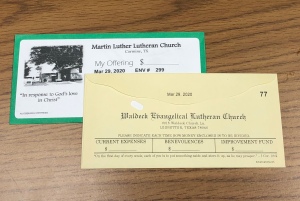
For both of our congregations, Waldeck and MLLC, please remember that our expenses continue even when we are unable to meet as usual.  Please make a point to give your offerings as you would on a typical week.  Here are some ideas of what to do:

For Waldeck Evangelical Lutheran Church in Ledbetter:

– send your offering by mail to the church office  – Waldeck Evangelical Lutheran Church; 6915 Waldeck Church Lane; Ledbetter, TX 78946

– set aside your offerings each week, and then bring these to church when you can be at worship again.

For MLLC in Carmine:

– send your offering by mail to the church office  – MLLC, P O BOX 362, Carmine, TX 78932-0362

– set aside your offerings each week, and then bring these to church when you can be at worship again.

– give offerings through the church web site:  mllccarmine.com/online-giving  This page has a link to our secure giving page.  Offerings can be made by bank draft, debit card, or credit card through this special web site.

YouTube Video Link

Here is the link for the YouTube video of this day’s service.


APRIL 26, 2020

Third Sunday of Easter

First Reading: Acts 2:14a, 36-41

A reading from Acts.

Today’s reading is the conclusion of Peter’s sermon preached following the giving of the Holy Spirit to the apostles on the day of Pentecost. The center of his preaching is the bold declaration that God has made the crucified Jesus both Lord and Christ.

14aPeter, standing with the eleven, raised his voice and addressed [the crowd], 36“Therefore let the entire house of Israel know with certainty that God has made him both Lord and Messiah, this Jesus whom you crucified.”
37Now when they heard this, they were cut to the heart and said to Peter and to the other apostles, “Brothers, what should we do?” 38Peter said to them, “Repent, and be baptized every one of you in the name of Jesus Christ so that your sins may be forgiven; and you will receive the gift of the Holy Spirit. 39For the promise is for you, for your children, and for all who are far away, everyone whom the Lord our God calls to him.” 40And he testified with many other arguments and exhorted them, saying, “Save yourselves from this corrupt generation.” 41So those who welcomed his message were baptized, and that day about three thousand persons were added.

The word of the Lord.  Thanks be to God.


Psalm: Psalm 116:1-4, 12-19

1I love the Lord, who has heard my voice,
and listened to my supplication,
2for the Lord has given ear to me
whenever I called.
3The cords of death entangled me; the anguish of the grave came upon me;
I came to grief and sorrow.
4Then I called upon the name of the Lord:
“O Lord, I pray you, save my life.” 
12How shall I repay the Lord
for all the good things God has done for me?
13I will lift the cup of salvation
and call on the name of the Lord.
14I will fulfill my vows to the Lord
in the presence of all God’s people.
15Precious in your sight, O Lord,
is the death of your servants.
16O Lord, truly I am your servant;
I am your servant, the child of your handmaid; you have freed me from my bonds.
17I will offer you the sacrifice of thanksgiving
and call upon the name of the Lord. 
18I will fulfill my vows to the Lord
in the presence of all God’s people,
19in the courts of the Lord‘s house,
in the midst of you, O Jerusalem. Hallelujah! 


Second Reading: 1 Peter 1:17-23

A reading from 1 Peter.

The imagery of exile is used to help the readers of this letter understand that they are strangers in a strange land. Christians no longer belong to this age. Through the death of Christ we belong to God, so that our focus, faith, and hope are no longer on such things as silver or gold.

17If you invoke as Father the one who judges all people impartially according to their deeds, live in reverent fear during the time of your exile. 18You know that you were ransomed from the futile ways inherited from your ancestors, not with perishable things like silver or gold, 19but with the precious blood of Christ, like that of a lamb without defect or blemish. 20He was destined before the foundation of the world, but was revealed at the end of the ages for your sake. 21Through him you have come to trust in God, who raised him from the dead and gave him glory, so that your faith and hope are set on God.
22Now that you have purified your souls by your obedience to the truth so that you have genuine mutual love, love one another deeply from the heart. 23You have been born anew, not of perishable but of imperishable seed, through the living and enduring word of God.

The word of the Lord. Thanks be to God.


Gospel: Luke 24:13-35

The holy gospel according to Luke.  Glory to you, O Lord.

The colorful story of Jesus’ appearance to two disciples on the road to Emmaus answers the question of how Jesus is to be recognized among us. Here, he is revealed through the scriptures and in the breaking of bread.

13Now on that same day [when Jesus had appeared to Mary Magdalene,] two [disciples] were going to a village called Emmaus, about seven miles from Jerusalem, 14and talking with each other about all these things that had happened. 15While they were talking and discussing, Jesus himself came near and went with them, 16but their eyes were kept from recognizing him. 17And he said to them, “What are you discussing with each other while you walk along?” They stood still, looking sad. 18Then one of them, whose name was Cleopas, answered him, “Are you the only stranger in Jerusalem who does not know the things that have taken place there in these days?” 19He asked them, “What things?” They replied, “The things about Jesus of Nazareth, who was a prophet mighty in deed and word before God and all the people, 20and how our chief priests and leaders handed him over to be condemned to death and crucified him. 21But we had hoped that he was the one to redeem Israel. Yes, and besides all this, it is now the third day since these things took place. 22Moreover, some women of our group astounded us. They were at the tomb early this morning, 23and when they did not find his body there, they came back and told us that they had indeed seen a vision of angels who said that he was alive. 24Some of those who were with us went to the tomb and found it just as the women had said; but they did not see him.” 25Then he said to them, “Oh, how foolish you are, and how slow of heart to believe all that the prophets have declared! 26Was it not necessary that the Messiah should suffer these things and then enter into his glory?” 27Then beginning with Moses and all the prophets, he interpreted to them the things about himself in all the scriptures.
28As they came near the village to which they were going, he walked ahead as if he were going on. 29But they urged him strongly, saying, “Stay with us, because it is almost evening and the day is now nearly over.” So he went in to stay with them. 30When he was at the table with them, he took bread, blessed and broke it, and gave it to them. 31Then their eyes were opened, and they recognized him; and he vanished from their sight. 32They said to each other, “Were not our hearts burning within us while he was talking to us on the road, while he was opening the scriptures to us?” 33That same hour they got up and returned to Jerusalem; and they found the eleven and their companions gathered together. 34They were saying, “The Lord has risen indeed, and he has appeared to Simon!” 35Then they told what had happened on the road, and how he had been made known to them in the breaking of the bread.

The gospel of the Lord. Praise to you, O Christ.


Devotion

By Pastor David Tinker

Luke 24:13-35               “Meet Jesus Christ”

Grace to you and peace from God our Father and the Lord Jesus Christ.

About six weeks ago my cousin Chuck died.  One thing I remember most about time with Chuck was eating meals with him and his family.  I have memories going back into the 1970s of gathering at the table for food and fellowship. Every Thanksgiving I think of his asking for the big turkey drumstick.  When I was a kid he was the first person I remember ever asking to have that piece on Thanksgiving.  With this, and other memories, Chuck is one of the people I think of now at mealtimes.

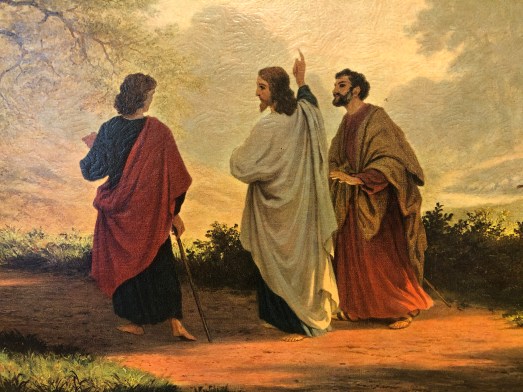
Looking to today’s reading from Luke, we have one of my favorite accounts of Jesus’ ministry.  On a road to the Village of Emmaus, two people met a stranger.  We know who this stranger was, but the travelers did not.  On that Sunday evening, following the Resurrection of Jesus, these two were speaking of the things that had happened that weekend.  Jesus, the stranger, catches up with these two and asks them what they are talking about.  Dumbfounded, these two just stop in their tracks.  How could this stranger not know what transpired over the weekend?

One, whose name was Cleopas, asked, “Are you the only stranger in Jerusalem who does not know the things that have taken place there in these days?”

The stranger asks, “What things?”

The traveling disciples answer, “The things about Jesus of Nazareth.”  The two continue to tell of all that happened with Jesus, and about the hope they held in him.  Then they say that there is talk of this Jesus being raised from the dead after being executed on a Roman torture cross.

Jesus, still unrecognized by these two, responds, “Oh, how foolish you are, and how slow of heart to believe all that the prophets have declared!  Was it not necessary that the Messiah should suffer these things and then enter into his glory?”  He followed up with an extensive Bible Study of all that related to himself, this Messiah of the God.

After all this, they still did not know it was him.  Likely, he did not say, “I am Jesus the Messiah.” At the end of the day’s travels they stop of for the night.  The two disciples offer hospitality to the stranger.  During the evening meal Jesus broke bread and blessed it, just as he had done a few days earlier.  He was offering them to the Holy Communion.  In this meal, in this breaking of the bread, these two disciples finally recognized him.  At that point he vanished from their sight.

At this they began to reflect on the past few hours of conversation.  They remembered how their spiritual hearts burned within them.  Later these two found the other disciples, and they told them how Jesus was made known to them in the breaking of the bread.  They recognized Jesus in the Holy Communion.

This point of meeting and recognizing Jesus was powerful.  He could tell them all about himself, but they wouldn’t recognize him until he did something to stir up their memories.  He used words and a physical element to open their eyes.  This breaking of bread opened up their memories and it all became clear.  A gush of memories flowed forth.  The breaking of bread showed them that this was the one who had gathered with the 12 Disciples on the night when he was betrayed.  During that meal he had given a new and special meaning to the bread and the wine of the Passover.  Later he would go and die on the cross for their sin.  This man with them that night on the road was the same one who had died and was now raised from the dead.  The breaking of the bread stirred their memories.

God blesses us in the Church with memory.  We remember meeting Jesus Christ.  Each time we break bread – as Communion is called in Luke’s writings – we are connected with Jesus.

Holy Communion has long been the most significant part of my Christian life.  Each time I receive the bread and the wine God reminds me of the richness of his love, and the connection I have with the community of fellow believers.

Sometimes when I receive the elements of bread and wine I am reconnected with the Last Supper of Jesus with his disciples.  I feel I am there with them.  The noises and aromas of the gathering become real for me.  The conversations interrupted by laughter, the wine, the bread, and the other foods are there.  It is as if they were just on the other side of the table with us.

Often I think of the Great Banquet with all the people of God.  I eagerly look forward to God’s promised Great Banquet in eternity.  Our Communion is a foretaste of the feast to come, and this is foundational to my celebration of the Eucharist.

Other times I am brought to the place of the Skull – Golgotha.  I see visions of Jesus suffering on the cross for us.  The scene is shaking, like an intense scene in a movie.  Darkness and cries fill the air.  I sometimes hear the hammering of nails into his arms and feet.  Hushed voices murmur in response to what his says in his agony.  Bored soldiers stand guard.  Blood is dripping from his wounds.  The women who stayed with him are weeping.  I remember this, and I am spiritually connected to this, because it is the fullest expression of God’s love for us.  From the earliest days of the Church, Christians have met frequently for Holy Communion.  The Lutheran standard in the Apology of the Augsburg Confession, a founding document of our movement, indicates that Lutheran Christians gather every Sunday for communion, and often more than once a week. We read in the article about the Mass (the worship service with Holy Communion): “For among us masses are celebrated every Lord’s Day and on the other festivals, in which the Sacrament is offered to those who wish to use it…”

Why such frequency?  We do this because it is so good and wonderful and significant.  It is one of the most important times when we meet Jesus Christ.  I look forward to our return to our regular gatherings for the Holy Communion following this health crisis.

With the Holy Communion we recognize Jesus and remember him at the breaking of the bread.  I pray that when we gather at the Lord’s table, the breaking of the bread will stir up in all of us a remembrance of all that Jesus Christ has done for the world.  I invite you to see it as an extremely significant and regular connection point with Jesus and his people.


*Prayers of Intercession

A:  Let us pray for the whole people of God in Christ Jesus, and for all people according to their needs.

A brief silence.

Loving God, Father, Son and Holy Spirit: You have called Your Church from the ends of the earth to be witnesses to the death, resurrection, and ascension of Jesus. Enliven our proclamation of the name of Jesus so that all may put their faith and hope in Jesus Christ. Lord, in your mercy,  hear our prayer.

Other petitions may be added here.

Sustain those who are struggling with illness of any kind, especially… and those we now name aloud or in quiet prayer… Strengthen those who suffer in any way from the recent pandemic. Lord in your mercy, hear our prayer.

We remember your servants of every time and place who have gone before us (especially…). We thank you that through the gift of faith you have taken delight in them. Give comfort to those who mourn.  Lord in your mercy, hear our prayer.

Lead us into the world to serve others in need.  Help us to love our neighbors as ourselves.  We give thanks for the opportunity to bring your mercy and goodness to those who are suffering, hungry, thirsty, and lonely.  Lord, in your mercy,  Hear our prayer.

P:  Into your hands, O Lord, we commend all for whom we pray, trusting in your mercy; through your Son, Jesus Christ our Lord.

Amen


Conclude with our LORD’S PRAYER

Prayer Request list for Waldeck Evangelical Lutheran Church of Ledbetter

Health and Well-being Prayer List:  Phillip Procell, Brian Shaffer, Sandra Gest, James Smith, Barbara Spence, April Weyand, Fritz Schoenst, Alicia McQuaig, Diana Garik Poentisch, Sally Beettner, Carrie Oltmann, Robin Hardin, Beverly Drescher


Martin Luther in Carmine Prayer Lists:

REMEMBER IN PRAYER: Carol Mertz Leitzel, Janet Schnell Beckworth (both friends of Praise Team leader Jolene Wickel, health concerns and in hospitals);  Ricky Eckert (brother of Ronnie Eckert, health concerns); Kalisa Pomykal (Paula Barrick’s sister, medical concerns); Kenny Lorenz (former member Robert Hinze’s relative, serious burns and numerous health concerns); Nancy Pietsch (former RT-C teacher, health concerns); Johnny Dunham (health concerns); Joyce Kelley (friend, health concerns); Jack Walsh (friend of Wade Eilers, recurring melanoma); Bill Clarke (friend of Daryl & Susan Ray, stage 4 cancer); Robert Vaughn (at Texas Neurology, thankful for extended stay for rehab); Carrie Bozarth (friend of Sedalia Ullrich, cancer); Edna Mae Krivacka (friend of Ed Eargle and Carol Carmean, back home, health concerns)


Sympathy to the families of Dora Miller; Jeannie Johnson  (grandmother of Matthew & Nick Colpetzer, Joshua Aranzolo, and Emily Ortiz); LaVerne Krumrey (friend from Brenham; Ruby Marburger Ivey (Nikki Pohl’s mother)

The Ongoing Prayer Concerns may be found in the monthly newsletter.


THIS WEEK at MLLC

Today             5:00 pm-AA Meeting (subject to change)

May 3             5:00 pm-AA Meeting (subject to change)


WORSHIP SERVICES are suspended until further notice.  See the church web site and the church Facebook page for details of online worship services.


CONFIRMATION will be postponed and a new date set when services resume.


LUTHERAN MISSION APPEAL envelopes are designated for Lutheran Disaster Response of the ELCA.  You may send contributions in the mail, or bring it by the office, with the check made out to MLLC and in the memo line, put Lutheran Disaster Response.  You may also go to the website to donate.

mlllccarmine/online-giving/

disaster relief – lutheran disaster response


VACATION BIBLE SCHOOL has been postponed.  The new date at MLLC will be August 2-6, 2020 from 5:30 – 7:45 p.m., with the theme Rocky Railway.  See the codes in the May newsletter to register your child and to volunteer.

Registration is also available at the church web site:  https://mllccarmine.com/vacation-bible-school-2020/


VACATION BIBLE SCHOOL at Bethlehem Lutheran in Round Top will be June 1-4 from 5:30 – 8:30 p.m. with the theme “Anchored.”  There are registration forms in the narthex and church office.  For more information contact Stacy Eilers at 979-639-1897.  Possibly to be postponed to a later date.


CHURCH COUNCIL MEMBER A person is needed to serve as chairperson of the Outreach/Care Committee.  Please consider serving in this role.


FINANCIAL INFORMATION FOR MLLC

Week ending 4/4/2020

Church Income                                           $2,118.00

Church Expenses                                        $5,936.23

Property Insurance                           3,936.50

Benevolences                                    1,158.00

Salaries & Benefits                          400.00

Postage                                               220.00

Bulletins                                            171.73

Miscellaneous                                   50.00

Net Loss:                                                       $3,818.23


Week ending 4/11/2020

Church Income                                           $7,076.00

Church Expenses                                        $4,839.70

Salaries & Benefits                          3,560.16

Utilities                                              800.54

Supplies                                             479.00

Net Income:                                                 $2,236.30

Year to Date Net Loss:                              $511.43

Devotion and Readings for April 24

Otterbein,_Indiana_Water_Tower


Bible Readings and Devotion for April 24, 2020


Here are the references for the readings.  Please look these up in your print Bible, your smartphone app Bible, or your online Bible:


John 4:12-19

1 Peter 4:12-19

Psalm 122

Psalm 123

Psalm 124

Psalm 125

Psalm 126

Ezekiel 14


Devotion for April 24, 2020

By Pastor David Tinker


In the town where I first served as pastor there was a story about how the community got its name.  The original name of the town was, “Pond Grove.”  To this day the city cemetery is called, “Pond Grove Cemetery.”  I was told that many decades ago there was a man in the city named William Otterbein Brown.  He ran the stage coach stop and inn.  He also served as the local postmaster.  At some point he had to complete a form for the postal service.  On this form there was a section to list the name of the town for the post office to use for official, national records.  Mr. Brown made an odd choice that day which is still in effect.  Instead of writing, “Pond Grove,” which was the name of the town, he wrote, “Otterbein.”  That was his middle name.  The postal service accepted this and it was now required for mailing letters to Pond Grove.  So, to avoid further issues, the town renamed itself, “Otterbein.”  The name has changed over time, but some still make mention of the old name, “Pond Grove.”

One of the lessons I work on teaching in my confirmation classes with junior high student is about how different words, places, and concepts are spoken of in multiple ways and contexts.  Here are a couple of examples.

The place where Moses met with the Lord in the exodus has multiple names.

Mount Sinai

Mount Horeb

The Mount of God

These are all the same place, but in different contexts and times.  It is not a contradiction.  It is a bit like, “Pond Grove,” and “Otterbein.”

Another example is, “Israel.”  This term is used many times in many contexts.  To understand what it means at various times in God’s Word, one must seek out the context of the use.  Here are several examples:

Israel: the special new name or nickname for Jacob.  It was given him in Genesis 32 by the one who wrestled with the patriarch all night long.

Israel: the family of Jacob/Israel who numbered about 70 when they went to Egypt. There were the 12 sons of Jacob and their families.

Israel: the various people of the 12 Tribes which formed from the families of these 12 sons.  They left their slavery in Egypt and eventually entered the promised land.

Israel: the united Kingdom ruled by Saul, then David, then by Solomon. ~1020 – 922 BC

Israel: the Northern Kingdom after the division of the of the nation after the death of Solomon.  This was a nation between 922 and 721 BC.  The Southern Kingdom took the name of the dominant tribe, Judah.

Israel: the bringing together of the history, faith and people of Israel and Judah into the one person, Jesus Christ.

Israel:  the figurative, “Body of Christ,” which is the whole family of Christians.  This noted as the “Israel of God” in Galatians 6:16.


So, Israel is a person, a family, a roaming nation, a united nation, and split off nation, a theological idea, and the regathering of humanity in Jesus.


That is where we get to today’s readings.  In Psalm 125:1 we read, “Those who trust in the Lord are like Mount Zion, which cannot be moved, but abides forever.”   The psalm writer uses the image of the Temple mount and the dwelling place of God to talk about something which keeps us forever.  This is both a literal and a figurative idea.  The real place is called, “Mount Zion.”  The figurative truth of God being steadfast with his people is called, “Zion.”


For followers of Jesus we use the term, “Zion,” in various ways.  Here are some examples:

Zion: the mountain on which the Temple was built

Zion: the Temple itself

Zion: the city of Jerusalem, which hosted the Temple.  This is the centerpiece of life and faith for the children of Israel over the centuries.

Zion: the relationship which the Lord provided for his people.

Zion: the place where God dwells anywhere in the world.

Zion: Jesus Christ, the one who replaces Priest, Sacrifice, and Temple for the world.

Zion: our faith connection with Jesus whenever and wherever he is for us.


This psalm is teaching us that, in Jesus, we have a firm and powerful foundation for our life and faith.  We get to connect with the eternal Zion, Jesus Christ.  We are held by the Lord, and we get to hold on to the Lord as well.  In faith we look to the eternal Zion, Jesus Christ.  As we are taught in John 4, we worship in Spirit and truth, and that happens anywhere in the creation where God and his people meet.  Zion is, in a sense, in Waldeck and Carmine, and in any place and at any time God and his people are gathered in Jesus Christ, the eternal Zion.  Jesus is where we connect with God, and he is a Zion of sorts for us.  Zion is where the Kingdom of God is present.  Zion is where the Holy Spirit seeks us out and draws us to Jesus.  Our spiritual Zion is Jesus.


Prayer

For the prayer use the words of this classic hymn, “O, Zion Haste”

O Zion, Haste


1    O Zion, haste, your mission high fulfilling,

to tell to all the world that God is light;

that he who made all nations is not willing

one soul should perish, lost in shades of night.


Refrain

Publish glad tidings, tidings of peace,

tidings of Jesus, redemption, and release.


2    Publish to ev’ry people, tongue, and nation

that God, in whom they live and move, is love;

tell how he stooped to save his lost creation

and died on earth that we might live above.  Refrain


3    Give of your own to bear the message glorious,

give of your wealth to speed them on their way,

pour out your soul for them in prayer victorious,

and haste the coming of the glorious day.  Refrain


4    He comes again! O Zion, ere you meet him,

make known to ev’ry heart his saving grace;

let none whom he has ransomed fail to greet him,

through your neglect, unfit to see his face.  Refrain


Text: Mary A. Thomson, 1834-1923


Amen.

Devotion and Readings for April 23

Jerusalem Temple model


Bible Readings and Devotion for April 23, 2020


Here are the references for the readings.  Please look these up in your print Bible, your smartphone app Bible, or your online Bible:


John 4:1-14

1 Peter 4:1-11

Psalm 118

Psalm 120

Psalm 121

Ezekiel 13


Devotion for April 23, 2020

By Pastor David Tinker

When I was a student at the University of Texas I was involved in student campus ministry.  The two groups I was involved with were the Lutheran Campus Ministry and InterVarsity Christian Fellowship.  I enjoyed the teaching offered by both groups.  At a Bible study meeting offered by InterVarsity we learned about and discussed Psalm 121. The teachings that day have stayed with me for about 35 years now.  Here are some of the things I learned that day, and which I have added to in the years since, regarding this beautiful psalm.

The context of the psalm is during the time of Ancient Israel.  It was most likely before the exile in Babylon (500s BC).  That means, its first context was the time between 1000 and 600 BC.

It is “Song of Ascents.”  This means it was a psalm, or song, which was sung by the people and at worship as they headed to Jerusalem and the Temple.  Jerusalem was built on hills.  The Temple was built on the hill or mountain called Zion.  The people understood that they were going up to the Temple, even though they may be heading to the city from a higher elevation.  It was up, and therefore they ascended to the Temple.  The psalms of ascent were about going up to the higher and more wonderful place of the presence of the Lord.  This psalm is about delighting in being in the Temple with the Lord.

We need to remember that there was a giant problem in this time of history.  The problem was that most of the people, and sometimes even the kings, were distracted in some way by the worship of pagan idols.  These idols were essentially fertility gods.  The Canaanite people who also lived in the Holy Land worshiped these various false gods.  Their rituals were meant to manipulate these false gods into providing favorable growing conditions for crops.  You will see mention of these false gods by the names of Ba’al, Baal, Asherah, Ashtoreth, etc.  For the most part these pagan idols and false gods were worshiped up in the hills outside the city of Jerusalem in locations called, “high places.”

The psalm begins with a pleasant sounding question, “I lift up my eyes to the hills—from where will my help come?”  In reality, it is not telling us or the people of ancient Israel to look for help from what is up in the hills.  The “high places” were a place of sin, death, and idolatry.  There would be no help from these pagan idols. There is no help coming from the powerless and fake statues in the high places who do nothing. So, the question is not to urge us toward the hills.  Rather, it is to dismiss the terrible idea of seeking to please the false gods.

To counter this, the psalm writer gives an alternative answer.  Rather than the false gods, the psalm write notes, “My help comes from the Lord, who made heaven and earth.”  In other words, those pagan idols are absolutely nothing.  The only true help is in the Lord our God. The Lord is not some statue on an altar up in the hills.  The Lord is the one, true God in all the universe.  The Lord is the one created all that is.  The Lord is forever.  The Lord reigns above all.  He is King of kings and Lord of lords.  We don’t manipulate this deity.  We simply and humbly rejoice in his goodness and mercy and glory and love.

The rest of the psalm tells of some of the beautiful and powerful ways that the Lord is with us, helps us, and protects us in the journey of life and faith.  The Lord is always with us, every day, every night, and everywhere we go.  The final verse is, “The Lord will keep your going out and your coming in from this time on and forevermore.”  This verse gives us peace.  It reminds us that the Lord is always.  This promise of the Lord is echoed in many and various ways elsewhere in the Holy Scriptures.

There are two of my favorite echo verses in God’s Holy Word.

Matthew 28:20b:  Jesus said, “And remember, I am with you always, to the end of the age.”

Revelation 21:  St. John shared this vision, “And I heard a loud voice from the throne saying, “See, the home of God is among mortals. He will dwell with them; they will be his peoples, and God himself will be with them; he will wipe every tear from their eyes. Death will be no more; mourning and crying and pain will be no more, for the first things have passed away.””

In eternity, God and his people will be together.  All the damage of sin will be gone.  All the grief of the fallen world is wiped away.  We will be restored fully to our connection with the Lord.

In the here and now we live in what Christians call, “The Already and Not Yet.”  This means that, through saving faith in Jesus, we are already participating in the forgiven life with Jesus.  It is not yet in full perfection.  We are given glimpses of this life with God through the revealed Word of God.

We are living in a challenging place. In faith in Christ we live with our lives in two places.  We are firmly planted in this world to live out our callings and ministries.  We are here side by side with our fellow Christians.

At the same time we are people who, by God’s abundant grace, know our future is sure and certain in God’s loving hands.  We live in the care of, “the Lord, who made heaven and earth.”


Prayer

Lord Jesus Christ, you have prepared a quiet place for us in your Father’s eternal home.  Watch over our welfare while we are on this perilous journey.  Keep us from harm and danger and bring us at last into eternal bliss and joy as you live and rule with the Father and the Holy Spirit, one God, now and forever. Amen.


Prayer from Lutheran Book of Worship. Copyright © 1978/2020 Augsburg Fortress. All rights reserved.


Devotion and Readings for April 22

26C6BEDD-5500-49B2-ADCD-DBE39BC1D0F4


Bible Readings and Devotion for April 22, 2020


Here are the references for the readings.  Please look these up in your print Bible, your smartphone app Bible, or your online Bible:

John 3:22-36

1 Peter 3:13-22

Psalm 119:129-176

Ezekiel 12


Devotion for April 22, 2020

By Pastor David Tinker

Psalm 119 has a common theme throughout.  It is an ode or sorts to the Word and Law of God.  As you read this psalm in its entirety you will discover a wide variety of descriptions of how we get to encounter the Word.  In today’s reading we have this comforting and amazing message of how we gain understanding of the Word.  We read in verse 130: “The unfolding of your words gives light; it imparts understanding to the simple.”

That phrase, “The unfolding of your words gives light…” What a beautiful concept.  God unfolds his words to us.  This gives an image of something being carefully wrapped in cloth.  It reminds me of a precious item which has been put away for safe keeping.  It is not hidden from us.  Rather, it has been wrapped as a gift to us.

Throughout our days of faith on this earth we are given this Word of God.  In one sense, the Word of God is fully available.  The Bible is a public document.  It is important that this be shared far and wide in the world.  This is clearly God’s will, for our Lord commanded that we spread his teachings to the world.  We read in Acts 1:7-8, where Jesus said to his Apostles, “It is not for you to know the times or periods that the Father has set by his own authority. But you will receive power when the Holy Spirit has come upon you; and you will be my witnesses in Jerusalem, in all Judea and Samaria, and to the ends of the earth.”  The witness of the Apostles is the core of the New Testament.  What they saw, and what the Holy Spirit stirred them to write, is what became the Gospel books, as well as various Epistles.  Their witness, the vision given by Jesus, and the work of the Holy Spirit, became Paul’s letters and other documents of the New Testament.

In another sense, the Word of God is more fully revealed to us throughout our lifetimes.  Most fully through God, the Holy Spirit, we grow in our understanding of the Word.  The Holy Spirit unfolds the word of God for us in many and various ways.  Here are some of the most familiar and common sources of God’s provision of deeper understanding and joy in God’s Word:

1) Repeated reading of the Bible.

2) Discussion, group study, and learning opportunities

3) Listening to sermons and Bible teaching

4) Seeking ways to live out what you have learned.  When you actually follow through with God’s instructions you get your life lined up with God’s work through you.  Focus your attention on the New Testament interpretation of God’s commands.  If something seems odd or uncomfortable, seek guidance from your pastor, a friend, or fellow Christians.

5) Praying for the Holy Spirit to be stirred up in your spiritual life.  This is the greatest thing for which we can pray in our lives.  In Luke 11:13, when teaching about prayer, Jesus says, “If you then, who are evil, know how to give good gifts to your children, how much more will the heavenly Father give the Holy Spirit to those who ask him!” This teaching passage in Luke 11 notes that even sinners want the best for the children.  He then teaches us that God’s love is immensely greater than the love of sinners.  Our loving God seeks to give us the best, and that very best thing is God the Holy Spirit in our lives.  Therefore, pray for the Holy Spirit to be more fully in your life.  In this, the Holy Spirit will unfold the scriptures for you.

6) Strive to understand how the Sacrament of Holy Communion reveals Jesus and his word to us.

7) Study teaching books about God and his Word.  Some authors who are especially excellent to read include:  Martin Luther, C. S. Lewis, and N. T. Wright.

8) Prayerfully mediate on the Word of God. Read a passage, a story, a verse, a psalm, etc. from the scriptures.  Pray for understanding, for the word to be unfolded for you.  Quietly ponder what you have read.  Seek to recognize what new things you have observed.

9) If you like to draw, paint, sketch, etc., use these to mediate on the word.

10) Write notes and reflections on what you have read.

These are just ten ways and suggestions for you.  The unfolding of the Word of God takes place throughout your lifetime.  Pray for love for God and his Word.  As you grow to love God more, you will grow in your patience with the process of unfolding the Word.  God is there for us.  Let us receive this unfolding of the Word as a wonderful grace of God.


Prayer

Blessed Lord God, you have caused the holy scriptures to be written for the nourishment of your people. Grant that we may hear them, read, mark, learn, and inwardly digest them, that, comforted by your promises, we may embrace and forever hold fast to the hope of eternal life, which you have given us in Jesus Christ, our Savior and Lord. Amen.


Prayer from Evangelical Lutheran Worship. Copyright © 2020 Augsburg Fortress. All rights reserved.